How to Scale Recipes by Servings for Meal Prep (and Build the Grocery List)
Most recipes serve four. Your household might be two, or five, or you might want leftovers for lunch. Scaling a recipe is simple multiplication. A few ingredients need judgment, and the real time-saver is turning a week of scaled recipes into one shopping list.
1. Find the scaling factor
Factor = servings you want ÷ servings the recipe makes. Want 6 from a recipe for 4? Factor 1.5. Want 2 from a recipe for 4? Factor 0.5. Multiply every ingredient quantity by the factor.
2. Convert awkward amounts
1.5 × ⅔ cup is 1 cup. 0.5 × 3 eggs is 1.5 eggs: use 1 large egg plus a little beaten egg, or round to whichever suits the dish. Useful equivalents: 3 teaspoons = 1 tablespoon, 16 tablespoons = 1 cup. For baking, weighing in grams avoids most of these headaches.
3. Ingredients that don't scale linearly
- Salt, spices and strong flavors: when scaling up a lot, start with a bit less than the full multiple and adjust to taste.
- Leavening (baking powder, yeast) in baked goods: large changes can affect results, so baking several normal batches is often safer than one giant one.
- Liquids that evaporate: a bigger pot loses liquid at a different rate, so check consistency.
- Cooking time and pan size: a doubled casserole in a deeper dish needs longer. Go by doneness, not the clock.
4. Plan the week, then combine
Pick the week's meals, scale each one to the number of people eating it, then add up identical ingredients across all recipes. Three recipes that each use an onion become "3 onions" on one line.
5. Subtract what you already have
Check the fridge and pantry before you shop and subtract what's on hand. This step is where most of the savings come from: fewer duplicate jars, less waste.
6. Estimate the cost
Put a rough price on each line using your last receipt. Over a few weeks you'll learn which meals are cheap and which quietly blow the budget. See how to meal plan on a grocery budget.
Our Meal Planner & Grocery List has a 21-meal weekly plan. Quantities scale with servings, what you already have is subtracted, and you get an estimated grocery cost.
General information. Check food safety guidance for storing prepared meals.
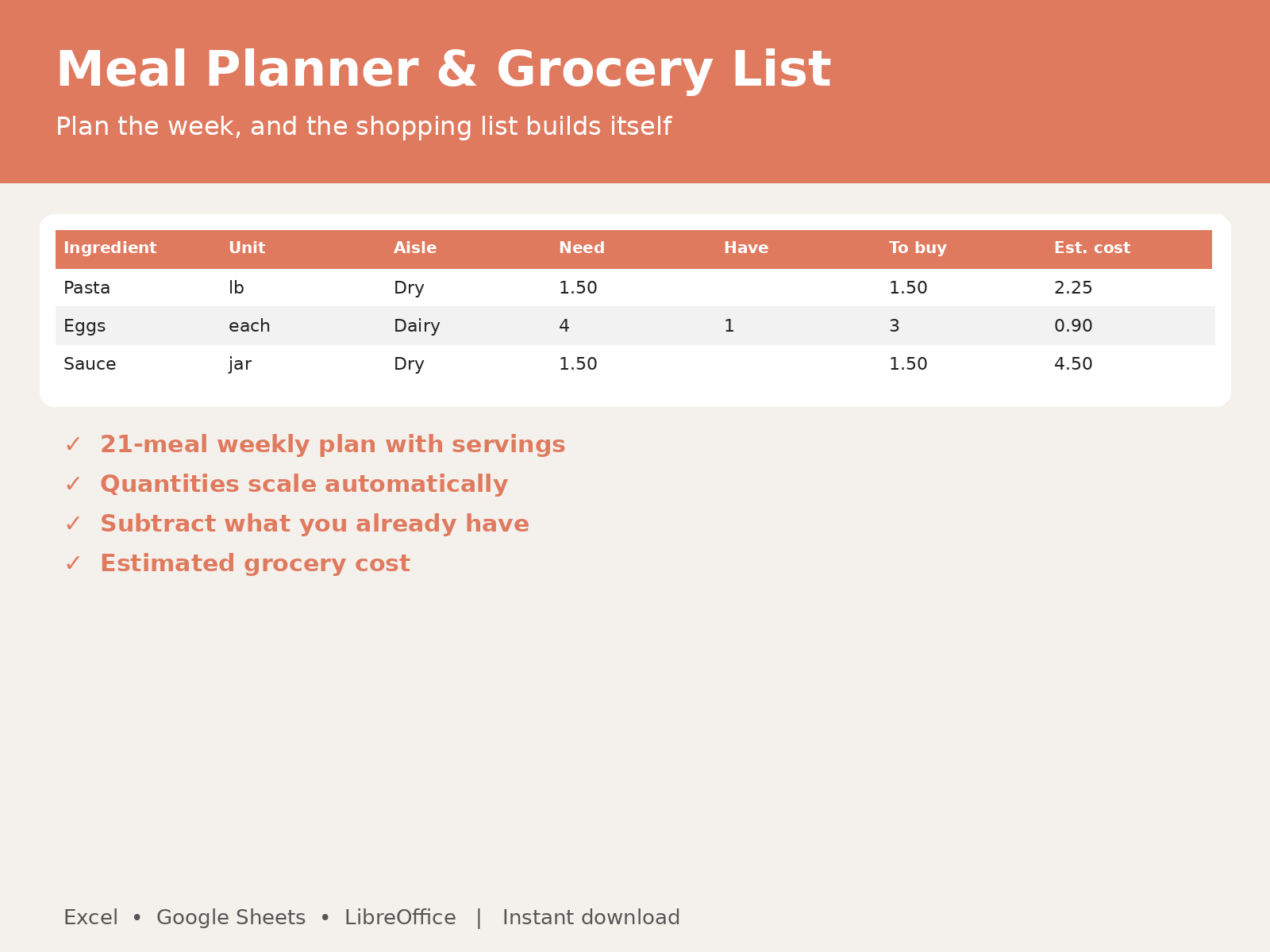
Meal Planner & Grocery List: instant download for Excel and Google Sheets.
Get the Meal Planner & Grocery List on Gumroad