Rental Property Cap Rate and Cash-on-Cash Return, Explained
Net operating income (NOI)
NOI = rental income − operating expenses (property tax, insurance, repairs, management, utilities you pay, HOA, an allowance for vacancy). Mortgage payments and capital improvements are not operating expenses, so NOI is the same whether you paid cash or borrowed.
Cap rate
Cap rate = NOI ÷ property price (or current value). It compares properties regardless of financing.
Cash-on-cash return
Cash-on-cash = annual pre-tax cash flow ÷ cash you actually invested (down payment, closing costs, upfront repairs). Cash flow = NOI − debt payments − capital spending. It answers the question "what is my money earning?"
Worked example
| Price | $250,000 |
| Rent | $2,000/month = $24,000/year |
| Operating expenses (tax $3,000, insurance $1,200, repairs $1,800, vacancy $1,200, management $1,200) | $8,400 |
| NOI | $15,600 |
| Cap rate | 15,600 ÷ 250,000 = 6.24% |
| Mortgage payments | $11,000/year |
| Cash flow | $4,600 |
| Cash invested | $60,000 |
| Cash-on-cash | 4,600 ÷ 60,000 ≈ 7.7% |
Common mistakes
- Leaving out vacancy and repairs, which makes the cap rate look great on paper.
- Counting the mortgage in NOI.
- Comparing a partial year with a full year's price. Use a full year, or label the figures as year-to-date.
Our tracker keeps one ledger for all your properties and separates operating costs from mortgage and capex automatically, so these figures stay right.
General information, not investment or tax advice.
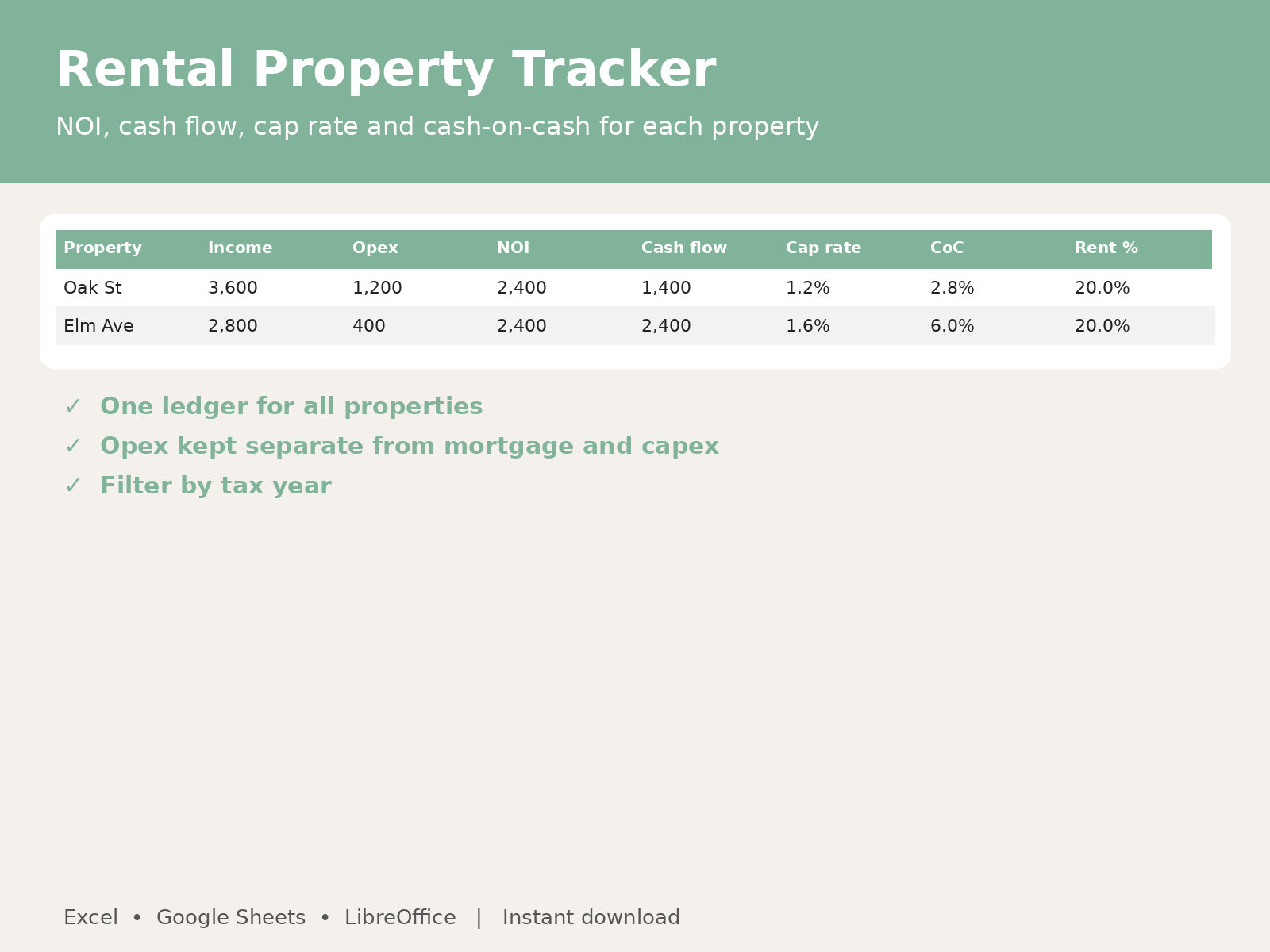
Rental Property Tracker: do this math automatically in Excel or Google Sheets.
See the Rental Property Tracker