How Much Should a Freelancer Set Aside for Quarterly Taxes?
When you work for yourself, nobody withholds tax from your pay. The IRS still expects tax during the year, so most US freelancers pay quarterly estimated taxes with Form 1040-ES. Here's how to work out what to put aside.
1. Self-employment tax: the part people forget
As an employee, you and your employer split Social Security and Medicare. Self-employed, you pay both halves: 15.3% (12.4% Social Security + 2.9% Medicare) on 92.35% of your net self-employment earnings. The 12.4% Social Security part applies only up to the wage base, $184,500 for 2026 (counting any W-2 wages too); the 2.9% Medicare part has no cap. An additional 0.9% Medicare tax applies above $200,000 (single) or $250,000 (married filing jointly). You owe self-employment tax once net self-employment earnings reach $400.
Example: $60,000 of net profit × 92.35% × 15.3% ≈ $8,478 in self-employment tax. Half of it (about $4,239) is deductible when you work out income tax.
2. Then income tax
On top of self-employment tax you owe regular federal income tax (and possibly state tax) on your profit after deductions. Your rate depends on your bracket, filing status and other income, so use your own effective rate from last year's return as a starting point.
3. A simple set-aside rule
Many freelancers move a fixed share of every payment, often 25–30%, into a separate savings account. A better approach is to calculate it: (profit × 92.35% × 15.3%) + (profit − half of SE tax) × your estimated income-tax rate. This is what the dashboard in our kit does (including the $400 threshold and the 2026 wage base), month by month and quarter by quarter, and it nets losing months against profitable ones.
4. Deadlines
For 2026, estimated payments are due April 15, June 15 and September 15, 2026, and January 15, 2027 (the next business day if a date falls on a weekend or holiday). They cover January–March, April–May, June–August and September–December, so the "quarters" aren't equal. You generally need to pay if you expect to owe at least $1,000 for the year after withholding and credits.
5. Safe harbor
You can generally avoid the underpayment penalty by paying, in timely installments, at least 90% of this year's tax or 100% of last year's tax (110% if last year's AGI was over $150,000, or $75,000 if married filing separately). Paying a quarter of last year's total each deadline is the simplest way to be safe while your income changes.
This is general information, not tax advice. Rules change, so Figures were checked against the 2026 Form 1040-ES, IRS estimated-tax FAQs and the IRS self-employment tax page; see IRS Publication 505 or a tax professional for your situation.
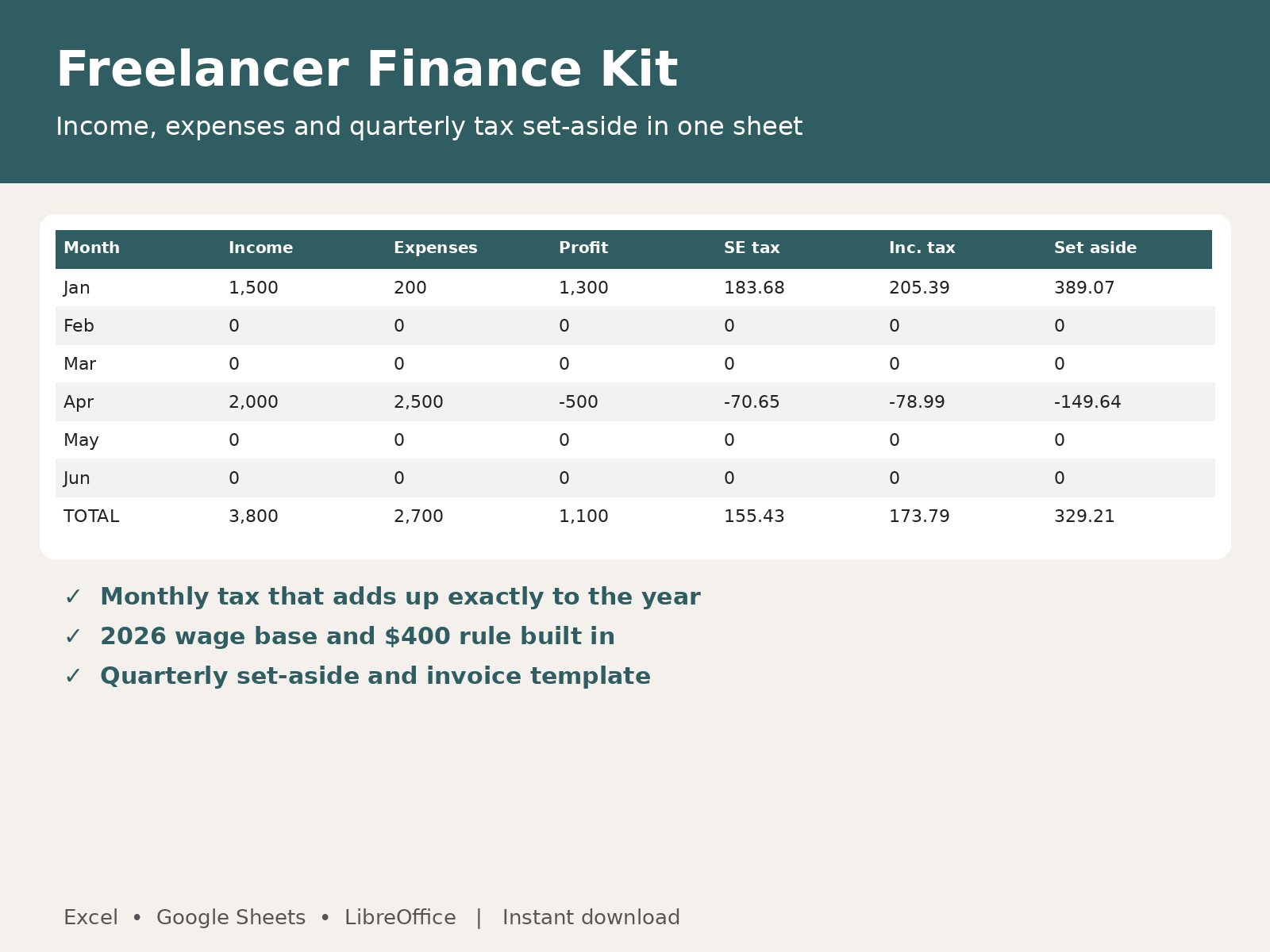
Freelancer Finance Kit: do this math automatically in Excel or Google Sheets.
See the Freelancer Finance Kit