How to Calculate Your Debt-to-Income Ratio
Your debt-to-income ratio (DTI) is the share of your gross monthly income that goes to debt payments. Lenders look at it when you apply for a mortgage or loan, and it's a useful number to track yourself.
The formula
DTI = total monthly debt payments ÷ gross monthly income × 100
Gross income means before tax. Debt payments usually include rent or mortgage payments, car loans, student loans, credit-card minimum payments and personal loans. Everyday costs such as groceries and utilities usually aren't counted.
Worked example
Gross income $5,000 a month. Payments: car $350, student loan $250, credit-card minimums $150, rent $1,400. Total $2,150. DTI = 2,150 ÷ 5,000 = 43%.
Without rent, the debts alone are $750, or 15%. Some lenders look at both figures, and the thresholds they use vary by lender and loan type, so check with the lender you're considering.
How to bring it down
Paying off a debt completely removes its whole minimum payment from the calculation, while a partial payment often doesn't change the minimum. That's one reason the debt snowball method (clearing the smallest balances first) can lower DTI quickly. The avalanche method (highest interest first) usually saves more interest overall.
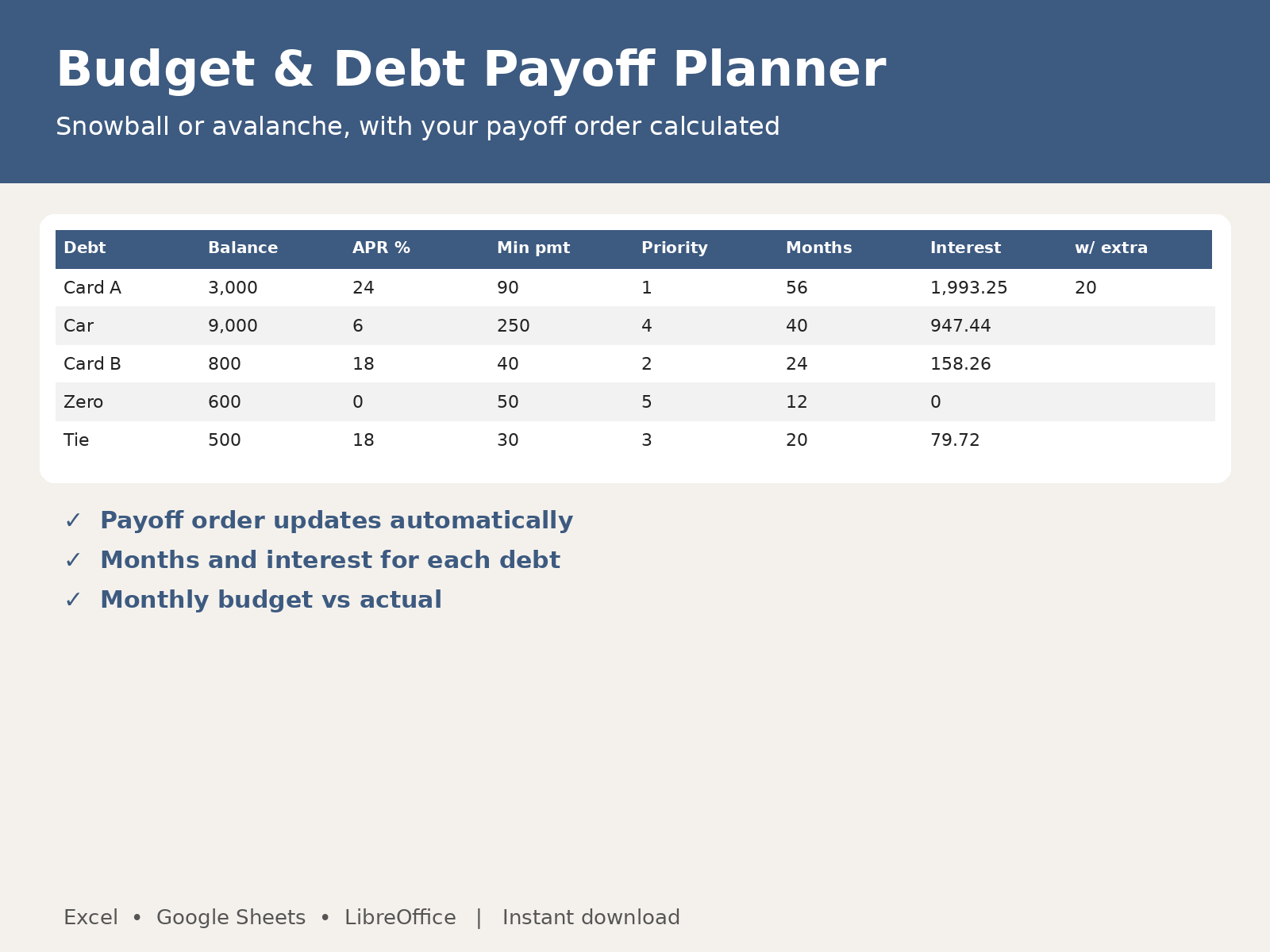
Budget & Debt Payoff Planner: do this math automatically in Excel or Google Sheets.
See the Budget & Debt Payoff Planner